- Part One: What Drove Me Away
- Part Two: Philosophy
- Part Three: Treasure Experience and Encumbrance
- Part Four: Combat, but Mostly Initiative
In this series I will attempt to explain AD&D to the 5E player in the hope of helping them understand what AD&D is all about and why certain rules exist. I don’t consider myself an expert in this regard and I do have an admittedly small target audience of seven; my players. I do hope this will be broadly helpful to others that stumble upon it and if I’ve made a mistake on some point or failed to elaborate on another I welcome feedback.
This is by no means comprehensive. I’ve instead tried to focus on a detailed exploration of a few topics that pushed me away from modern RPGs.
Abstract
This article is long and could go much longer if I indulged every observation I’ve made over nine years of playing 5E. If long is not your thing I’ve attempted to boil the main points down to single sentences.
Skills are unnecessary and detract from the game by limiting player options.
Most monsters don’t need much complexity since their job is to provide conflict and further plot.
Role-Playing is the key to interacting with the world in a limitless way.
The modern design philosophy is incongruent with my own.
Dispassionate master of the world. Not tyrannical rules lawyer.
Skills
It’s likely that all of my players have heard me say, “I hate skills,” but most are not so steeped in the hobby specifically and in gaming generally to be interested in a long form analysis on the subject. While I hold to the sentiment a more accurate statement would be, “I hate the type of game a universal skill system tends to produce.”
Others before me have written well thought out analysis. The Simulacrum blog discusses the impact of skills on the game in, A Historical Look at the OSR — Part II. The Whole series is absolutely worth reading but if you’re not inclined to read very long links I think a quote from Steve Winter from footnote 11 sums up my own observations.
“The counter argument, which I seldom hear, is that relying on a numerical system to resolve skill use rewards players who are good number maximizers at the expense of those who are not. By favoring one approach over the other, aren’t we just swapping one type of player talent for another?”
— Steve Winter
My experience of how players use skills in the 5E game has been similar. Players invest in scores and the feats to give their skills bonuses intending to use them as broadly and frequently as possible. With skills, as with all other player facing rules, the players always (and I mean always) interpret them to work as favorably as possible. Thus Insight becomes “lie detector”, Intimidation becomes “fear”, Persuasion becomes “command”, Perception becomes “immunity to surprise” and Investigation becomes my personal favorite, “stop your yammering DM and tell me what I find!”
The secondary issue with a universal skill system is that all players want to attempt all rolls which of course seems fair and expected since the skills are listed on everyone’s character sheet. But everyone rolling produces consistently odd results as a bad roll prevents the Wizard trained in Arcana from recognizing something the untrained Barbarian with a good roll does.
Bad rolls further compound the problem as a string of them at any given time can lock the party out of discovering some pertinent fact about the game. Conversely a string of great rolls can put the game on easy mode allowing the players to detect and know all things thus removing uncertainty and therefore mystery (and challenge) from the game.
In a system without universal skills the DM is free to prompt the player as, “Milamber, you’re from the local area and therefore you’d know something of the history,” and then fill in some blank for the player. One could argue of course that a universal skill system allows the DM to ask Milamber to make a history check. But if we’re playing R.A.W. and Milamber’s player rolls poorly the bad roll problem still confounds the game. If the DM rolls in secret in order to fudge the bad roll then why roll at all?
All of this being a long form way of saying that the first sin a universal skill system commits is to eliminate role-playing (covered below) from the game. The second sin of the universal skill system is that it trains players to interact with the world (outside of combat at least) via their skills. Within this framework players with imaginative solutions that fall partially or totally outside of the defined skills often struggle to fit their idea into the skills framework. Some never attempt solutions outside the skills framework. The modern DM is likewise limited by skills and would necessarily lack the tools to recognize the struggling player and draw out their idea. The result is a game bounded by skills instead of a game with infinite possibilities.
There is of course a contrary perspective on skills which is often expressed as something akin to, “skills allow me to create a character that is good at a thing that I’m not.” I agree with the sentiment but it denies two realities. Firstly that a player need only describe how they’d like their character to interact with the world (role-playing) not actually have a matching real life skill. Secondly that in what is now called old-school we tended to reward role-playing. Sometimes with automatic success, other times mechanically and still other times with more role-playing. Which is to say the character would build reputation for being good at something as the player accumulated successes. Either way role-play is an important aspect (perhaps the most important aspect) of emergent game-play. In this case the capabilities of the character emerging during play rather than at the time of creation.
The third sin of the universal skill system (and this is shared with other mechanics) is that characters are birthed into the game world fully formed with nothing new to discover about themselves through participation in the game. For some this may be the the ideal form but in my experience it tends to create (or train) players wholly caught up in what their character is rather than what their character can contribute to the group.
Look no further than the 5E group and the AD&D group. During a session zero the 5E player will know exactly what their character is. The AD&D player will as often as not ask, “What does the party need?”
In conclusion the effect of a universal skill system is to fence in player creativity reducing it to a sub set of fairly predictable interactions with a fairly predictable rate of success and failure making for (in my opinion) a bland game. AD&D certainly has skills1 but it does not have (at least in the core books) a universal skill system. Thus the game has skills enough for players to roll when appropriate while remaining open enough for player creativity to trump rolling dice. As a final example searching for a secret door could take the form of rolling an Investigation check (universal skill system) or rolling on a d6 (AD&D search for secret doors) or the players could by drawing a map deduce where a secret door is likely to be thus obviating the need for any dice rolling.2
Monsters
The Dungeon Master of a given game has a lot to juggle. Maps whether preparing battle maps or tracking the player’s progress on a map behind the screen. Various NPCs, their personalities, knowledge, names and history with the party. Plot, preparing locations, remembering events and answering the natural flow of questions from all of the players.
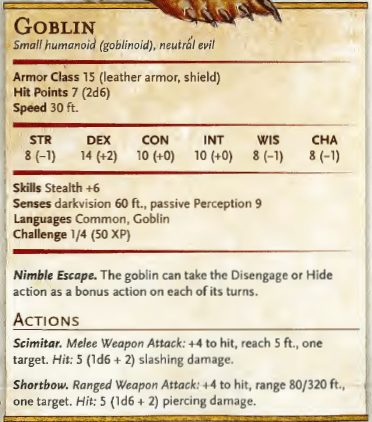
The DM must also be prepared to run combat and depending upon their system of choice that may also be a large responsibility. If the DM‘s chosen system is 5E then they’ll need to be prepared to run groups of monsters with stat blocks complex enough to make them miniature player characters.
As any DM should be able to tell you the most difficult type of monster to run against the players is the evil party because characters have the most complex set of options. This should not be a controversial statement considering each edition has a volume dedicated solely to the players. Modern games have tended toward monster stats based on player stats which in turn has led to even simple monsters being somewhat complex to run. (goblin left)3
Here it’s worth pausing to ask if a high level of creature complexity adds to or subtracts from a system that enshrines balanced encounter design in the rules.4 Experience has shown there is no clear answer. Goblins such as this may give casual groups a hard time or (if played optimally5) even prove deadly. If your group is made up of the aforementioned numbers maximizers these goblins may offer little challenge.
Experience has also shown the issue of challenge tends to remain fairly flat for casual groups over time while compounding for the min-maxxers. By about 5th level and definitely by 11th the better number maximizing players have typically grown to the point where nothing in the Monster Manual, perhaps short of the Tarrasque, offers any meaningful challenge.
The Dungeon Master’s guide offers tools for encounter design using the CR System to plan “…six to eight medium or hard encounters in a day.”6 Here again the system is unreliable (I assign no fault to the authors) since it’s unable to account for party composition, magical items and player ability to maximize numbers. However the encounter design system seems to fail to account for the large incentive to rest7; an incentive that even casual players don’t miss. And published material fails to deliver8 an example of the 6-8 encounter adventuring day.
Before digressing too far I’d like to return to an important earlier parenthetical; if played optimally. The apparent intention is for the DM to carefully investigate the monsters in order to play them in their most deadly fashion5, prepare encounters with an XP budget9 and somehow cajole the players into 6-8 encounters.6 All this and remember, “D&D isn’t a game of DM vs Players.”
So does the complexity add to or subtract from the game? That seems to come down to taste.
Earlier editions had no notion of balance and much simpler monster stats while also being “notoriously” deadly. Newer editions have longer monster stat blocks and are much less deadly. At minimum we can’t argue that a longer stat block makes for a deadlier monster. If any observation can be made here it seems that monster complexity keeps pace with character complexity. But if complex stat blocks make for less deadly monsters why bother with the additional cognitive load?
Not every monster encounter is meant to be epic. Sometimes the monsters are fodder for the story, other times they’re just in a place where it makes sense for them to be and still other times they’re wandering around.
The players sometimes do the unexpected and talk to the monsters forcing DMs to come up with names on the spot. Occasionally we DMs say or do something in the persona of a monster that engages our players in such a way that what might have started as a random encounter leads to the players making a valued friend or a hated enemy.
In other words what makes a monster great isn’t the length of their stat block (which is invisible to players) it’s the interaction the party has with them. If a significant amount of time must be spent with the stats in order to play the monster in combat well that’s time not spent on other more interesting aspects of monster encounters.
In conclusion longer stat blocks increase cognitive load, combat time and preparation time without significantly enhancing the player experience of monsters. Meanwhile the behind the scenes expectation seems to be that DMs should be running a war-game against their players. I’ve met some who are. I’ve met players who love it. But I am not among them. In my opinion if you’re playing a war-game against your players you’ve all ready lost.
And A Gripe About Weak Sauce
There is a story I tell mostly in my mind that I call, “A Tale of Two Dragons.” I had a particular group of 5E players of about 6th level fight an adult dragon. They were good numbers optimizers and two rounds later the dragon was dead. I had a different group of players this time playing 2E and also of about 6th level decide to fight a dragon. It breathed once and they fled for their lives. Why hobble the eponymous creature by putting the breath weapon on a recharge timer and removing spell casting while giving several of the classes some way to mitigate AOEs?
Then there is Demon Lords who are apparently meat for the PC grinder. How does “SPECIAL DEFENSES: +2 or better weapon to hit.”10 grab you?
Role-Playing
These days it seems like role-playing has been reduced to the adopting of a persona and the making of funny voices or acting. Actors can be immensely fun to play with but in my forty-ish years of experience actors are by far the smallest group players. Most of us (myself certainly included) aren’t actors. Does that mean role-playing is closed to us?
No, no it does not.
There was a time in the past when acting was considered a facet of role-play which was a broader term meaning to act as if you (the player) were living in the world and describe the actions you’d like your character to take accordingly.
For example, when attempting to intimidate a guard in a universal skill system one would simply say, “I roll Intimidation,” perhaps leaving the DM to ask what the player hopes to achieve. That interaction is however just as easy to play without skills. The player can simply say, “I stride up to the shortest guard, look down at him and say, ‘I’ve got some questions and you’re going to give me answers’.”
This approach is inadvisable in either case because it fails to account for the world around the character that might conspire to discourage such behaviour. The guard for example would certainly close ranks to assert their authority over the character. The problem here is that the universal skills player is very likely to say, “I rolled high, they should be afraid of me now.” That could certainly be true if the player has isolated a single coward but walking into a group and issuing threats is quite a different story.
A role-player on the other hand is likely to take a more nuanced approach. That player may say, “I take a moment to size up the guard. I’m looking at the guard’s posture and eye contact. Does my character think the guard is cowardly?” After a moment of consideration the DM may reply, “The guard slouches and avoids eye contact. He seems to shrink from his overbearing sergeant.”
The player, if they’ve paid attention, now knows that they can in all likelihood intimidate the guard but would be wise to do so out of earshot of the sergeant. If the player has indeed made those observations and approaches the guard accordingly they’d have free reign to intimidate the guard into answering their questions. If the players made no note of the sergeant they may achieve some limited form of success with the sergeant interrupting at a critical moment. They may also decide to forgo intimidation in favor of sympathizing with the poor fellow perhaps making a friend and long term contact in the guard.
Alternatively the DM could decide that close observation of the guard does not reveal cowardice but instead avarice as the guard pockets coin from some allowing them free passage through the gate while needlessly questioning others making their passage through his post as tedious as possible.
Role-playing is therefore a give and take between player and DM. When the player indicates to the DM what they’re hoping to observe, “posture and eye contact”, the DM is given an idea to work with and important insight into the player’s way of thinking. This in turn allows the DM to build upon the player’s idea. Is the guard susceptible to intimidation? Now the DM can confirm it, divert it or stymie it based on the needs of the game.
This is important for a few reasons. Firstly that not every NPC is a similar difficulty class for the players to beat but instead an individual in the game world. Secondly that players aren’t discouraged when even high rolls fail; there are after all incorruptible guards. Third, and most important, that the free flow of ideas back and forth tend to spark better fail states11.
A player who rolls Intimidation is asking for a summary judgment on the success of their roll. A player engaged with the game as a role-player is likely to get helpful information from the DM if only because their statement of intention helps the DM generate ideas on the fly.
For instance I may have decided that this particular gate is guarded by an incorruptible guards but when the players go for it regardless I may have a guard say in his pride, “This isn’t the west gate, that sort of behaviour won’t be tolerated here.” This informs the players in a single sentence that there is factionalism among the guard and where to go if they want to succeed. The game may therefore continue to move forward.
To role-play all the player has to do is pay attention to the world the DM is presenting, think about the world as if they’re living in it and describe the actions they’d like to take. No need for funny voices or speaking or thinking in character.
Of course role-play (also called interrogative play) is not limited to social encounters. Player’s may deduce the location of a hidden dungeon from looking at a map or gathering local rumors. They may divine the plans of the evil army through capturing messengers. They may in fact attempt to solve any problem through any means they can imagine without having to force the solution into a limiting structure that is a skills system.
Role-play therefore creates a game of limitless possibilities. The players attempt any solution they can imagine and the DM judges it fairly. Fair doesn’t mean the players always succeed. On the contrary there is often a chance of failure.
Taking the above example if the players only had a few moments to observe the guard before acting an attempt at intimidation would carry with is some risk. In this case the DM might call for an ability roll to determine success.
Creative solutions need not be boiled down to pass/fail they may also introduce trade-offs for the players to weigh.
The players may decide to hire an NPC to map for them; not so covertly pushing mapping back on the DM. The NPC would in turn charge the party a rate worth his risk and carry some amount of equipment in order to ply his trade. The players would be able to produce accurate maps but the additional equipment and time to create maps would introduce risk. The extra bulky equipment would lower their ability to be stealthy and avoid encounters. The increased time it would take to set up the equipment and draw maps in the dungeon would increase their exploration time thus elevating their risk of random encounters. Should a battle begin to go against them the cowardly henchman might just flee with the map.
In conclusion role-playing is the key to a game whose outer limits are set only by the imaginations of the people participating in it.
Design Philosophy
In a recent video discussing the next Dungeon Master’s Guide Lead Designer Chris Perkins mentions in an off-handed way they the guide will contain helpful advice for the DM, “…to allow your players to contribute to the story while at the same time getting to the plot.”12 I don’t consider this to be inherently bad advice but it’s also indicative of a design philosophy counter to my own.13
For this we can again look at the excellent series A Historical Look at the OSR — Part I in which the author discusses old school modules. His observations align with my own experiences as a teen. As the Dragonlance novels grew in popularity and AD&D gave way to 2E there was a greater focus on epic story telling or as I like to call it campaign play. While players sought and indeed continue to seek this style of epic game it has in my experience two critical flaws.
In the first place epic stories need a high degree of central control so certain dramatic beats or plot elements can happen. In the case of a novel this is a simple enough feat since the author controls all of the action. In a game however players have individual control over their characters (as they should) which makes hitting those beats nigh impossible. Epic stories must therefore limit player autonomy in some fashion. In my experience players always rebel against this.
For example. An excellent dramatic moment could be a messenger delivering critical news to the players then succumbing to his wounds and dying. The players will typically (in any style of game) attempt to immediately thwart the dramatic moment with potions and spells. The messenger must be saved because exertion of player will over the game is always (or nearly so) paramount. And in a highly mechanical game this is just so. The messenger had hit-points and we (the players) have the ability to restore hit points, we therefore win. Any DM explanation of the messenger being too far gone tends to leave the players dissatisfied despite exhaustion rules.14
The alternative approach to controlling the story is to “cleverly” disguise the adventure’s limited nature by making it seem wide open ala Barovia in “Curse of Strahd” or the Sword Coast in “Storm King’s Thunder” (and others) while keeping them fairly limited. The limits are simple, one location can only produce enough plot to lead the players to the next location. Modern adventures ultimately take the Plotted Approach which we used to call a rail road. All aboard the plot train, woo woo!
In the second place most adventures don’t have a plot significantly complex enough to lead the players through many levels of play without padding most of the levels with meandering quests or plot filler ultimately designed to pad the game to level whatever. If you’ve ever read (or watched) Lord of the Rings you may have asked, “Why couldn’t the eagles just fly Frodo to Mt. Doom?” If you’ve ever played “Curse of Strahd” you may have wondered why you spent nine levels horsing around in Barovia when you knew from the beginning the goal was to kill Strahd. I’m equally guilty of making this mistake (sadly several times) in my own games. Ultimately games are reduced to an exercise in harvesting XP while delaying the inevitable.
I’m not arguing that the campaign can’t work. I’ve seen it work many times. Typically though it works with a more passive group of players who are willing to coast along with the plot because, “we’re playing D&D.” But I was raised (as a DM) by a mercenary group of friends who at the slightest hint of “have to” would immediately trot off as far as possible from anything resembling plot.
What’s the Alternative?
Old school adventures tended to be location based, replete with stat blocks and warring factions but without strict story structure.15 The game had the players either stuck in or able to visit an environment in which their interactions and decisions drove story. Aligning with one faction may for instance put the players at odds with another. Players could pit factions against one another. In fact players could pick their own path through an environment or when outgrowing it move on to another.
The key here is that player autonomy creates the story. The environment is in motion when the players arrive. Their actions have a direct impact on the environment causing it to change in some way. The DM adapts the environment and the story emerges rather than being predetermined.
This is the kind of game we told nerdy stories about as kids. This is the kind of game where the players bond with their characters and want to tell their tales to polite but disinterested third parties. Even now about 25 years since my last 2E campaign I can get those players to talk about that game.
Some may know this style as a sand box game or a West Marches game but back in the old days we called it an open world or open environment game. This is style of game is intimidating to run and I could fully digress here on the subject but that’s a matter for another article.
The strength of this style is that the player’s ultimately drive the plot rather than boarding the DM‘s plot train. While running this style of game is technically possible in any rule system it is made much more difficult in systems that demand battle maps and have monster stat-blocks starting at one quarter of a page. A system in which the players are expected to map and a monster encounter can be summed up thusly (AC 7; HD 3\*; hp 13 each; MV 40'; #AT 1; D 1-4; Save F3; ML 8; AL C)15 makes running this style of game much more accessible.
Open world is not without flaws of course. Some small portion of your players must be the type that want to engage more deeply with the world. Build a tower. Start a thieves guild. Fight a war over some slight from five sessions ago. The DM also must be prepared for a level of improv that make many quake. What if my players go to a place I haven’t prepared or ask a question I’m not ready for? Well that’s what makes it fun.
Rulings over Rules
There is a valid concern among certain players when they hear the phrase, “Rulings over Rules.” It conjures for some the nervous feeling of arbitrary tyranny on the part of the DM. That couldn’t be farther from the truth.
If you’ve taken to heart that a game does not need a universal skill system and that role-play is the key to unlimited possibilities then you can’t expect the rule books to have a rule for everything. The collective imagination of a group of players is far more expansive than any rule system. If it were otherwise, the rules being far more expansive than the imaginations of the people playing, then the rule books would be far too long to be useful.
This is where “Rulings over Rules” steps in. For example when a player wants to make a long jump across a pit in AD&D there are no rules for how to execute a long jump. The player would instead make an argument for why the long jump is possible perhaps citing that competitive long jumpers routinely clear 7 meters, or about 21 feet and since the character is exceptionally strong they should be able to clear the pit without a problem. The DM of course would point out that long jumpers aren’t typically laden with 70 pounds of armor, several weapons and a sack full of coins.
There is a bit of a give and take here but if the player wants to guarantee success they’re going to have to ditch the equipment which could expose them to danger on the other side. Or the player may wish to doff some portion of their equipment and try the jump in which case the DM would probably decide there is a chance of failure and tell the player to make a Strength check.
Whatever the case the point of “Rulings of Rules” is not arbitrary tyranny but a collaborative way to ground player ideas in mechanical reality. Yes you can try to long jump that pit in full plate. No you’re not guaranteed to success.
More importantly a fair ruling can be established with a little cooperation from everyone at the table without everyone having to wait while one person searches for an only occasionally used rule.
Conclusion
In the end many will read what I’ve written above and come to the conclusion that I’ve laid out a system independent philosophy. I understand that point of view but it’s incorrect.
If I were to strip away skills, overpowered class options, untangle the deeply entwined rules, rewrite all of the monsters and remove or rework other aspects of the game I haven’t gone into here; Resting, ASIs, Feats, Multi-classing, coinage and so on. That game wouldn’t be 5E.
If I made all of the changes I desired I’d have a game very close to AD&D. Recognizing that and all of the wonderful books and modules released by TSR and fans I’d be a fool to make any other choice.
Epilogue
I’ve played 5E since its release all the while grasping at an ephemeral notion that the game I was playing was somehow just not D&D. A lot of tangential explorations and friendly debates left me feeling no more satisfied. As 5E consumed more hobby time I slowly discovered OSR blogs. While I’m sure I’ve seen less than 1% of what’s out there I’ve been inspired to learn that a group of my peers had been having the same thoughts and making the same observations 10 or 20 years earlier.
Here and in the footnotes are just some of those influential sources.
Why old school games are awesome has been said before and better. A Quick Primer for Old School Gaming.
Healing, Death Saves and Spells are also problems. BECMI Berserker: The 3 Reasons why I left 5th edition Dungeons and Dragons for old school BECMI.
Do you love the game or the logo? Grumpy Old Grognard: Dungeons & Dragons was Dead Long Before the OGL 1.1 Came Along.
Years of half-assery: Mr. Welch: I didn’t leave 5th edition D&D, 5th Edition D&D left me.
Foot Notes
- Though about B/X D&D the observations seem to me no less true about AD&D; The skills you didn’t know you had. Old school musings on the B/X skill system.
- I’m aware that finding secret doors by deduction could be applied to either 5E or AD&D but that discussion also requires an unpacking of how mapping is handled in both games which I will discuss in a future installment.
- Various, Goblin: Monster Manual (Renton: Wizards of the Coast LLC, 2014), 166.
- While I can’t point to a specific use of the term “encounter balance” it is certainly implied in the DM‘s Guide (Creating a Combat Encounter, 81) and a common enough phrase in the community that players and DMs generally would recognize it and agree that 5E encounters should be balanced.
- How D&D Monsters Are Now Tougher in ‘Mordenkainen Presents: Monsters of the Multiverse’.
- Various, The Adventuring Day: Dungeon Master’s Guide (Renton: Wizards of the Coast LLC, 2014), 84.
- “Taking “Curse of Strahd” as an example the players can fight Doru, then take a long rest. Go to Old Bone Grinder, fight and make it to Vallaki for a long rest. Then perhaps a big fight in Vallaki and a long rest. On to Wizard of Wines, Yester Hill and so on.”
- I’m sure someone can point to an example in “Dungeon of the Mad Mage” or “Princes of the Apocolypse” or some other where dungeon delving does provide for a 6-8 encounter adventuring day but this would be the exception rather than the norm.
- Various, Evaluating Encounter Difficulty: Dungeon Master’s Guide (Renton: Wizards of the Coast LLC, 2014), 82.
- Gary Gygax, Demogorgon: Monster Manual (Lake Geneva: TSR Games,<br/> 1977), 16.
- I am of course aware that skills don’t merely need to be pass fail but on many occasions should fall back to fail states the player can recover from. However the player that rolls an unsolicited check with no role-play is ultimately asking for the DM to do their imagining for them. No thank you. Matthew Colville: Many Fail States | Running the Game
- New Dungeon Master’s Guide | Deep Dive | Core Rulebook | 5E | D&D. Or see this time-stamp.
- This is not the only indicator. If we recall Jeremy Crawford’s comments on “Monsters of the Multiverse”, “…it was too easy for a DMs to pick a sequence of things that was not that set of most optimal options.” And if only for the purpose of this article we’ll take it as given that skills are an invisible limit on player creativity. Then we’ll find that the game is developed by people who desire to herd players into their plot lines while playing a war game against them.
- It’s curious that as D&D games have evolved toward vehicles for epic stories they’ve also evolved toward empowering players to exert more will over the world around them vis-à-vis their many skills, abilities and spells. These are at best two incongruous developments. For an epic story to happen tragedy must occur and evil must be narrowly thwarted but the powers available to the characters make reversing tragedy and thwarting evil a small matter.
- See The Lost City or Keep on the Borderlands
- Tom Moldvay, The Lost City </span>(Lake Geneva: TSR Games, 1982), 18.
Discover more from Sage Jim
Subscribe to get the latest posts sent to your email.
 Sage Jim
3 thoughts on “AD&D for 5E Players: What Drove Me Away”